
If your company's profits exceed £250,000, HMRC is now claiming a full 25% slice of your hard-earned success. It is a sobering figure. You've likely felt the sting of rising rates whilst trying to navigate the complex marginal relief calculations that kick in once you surpass the £50,000 threshold. It feels like the goalposts are constantly moving. At Malik AccounTax Ltd, we believe you should pay what you owe, but not a penny more. This is why learning how to reduce corporation tax bill through proactive planning is now a vital survival skill for every UK director.
This 2026 strategic guide reveals the most effective, legal ways to reduce corporation tax bill whilst remaining fully compliant with HMRC. We'll move past basic receipt-gathering to focus on high-impact, "Guardian-style" accounting that protects your bottom line. You will learn how to use the new 40% first-year allowances, the updated 20% merged R&D credit, and the most tax-efficient remuneration structures to reduce the corporation tax bill for the 2026/27 tax year. Clear strategy. Real results. Let's ensure your accountant is working as hard as you are.
Key Takeaways
- Navigate the 2026 dual-rate system with confidence by understanding how marginal relief thresholds impact your company's effective tax rate.
- Identify often-overlooked allowable expenses under the "wholly and exclusively" rule to ensure you aren't leaving money on the table at year-end.
- Use the £1 million Annual Investment Allowance and the new 2026 capital reliefs to reduce your corporation tax bill while upgrading your business equipment.
- Optimise your personal take-home pay by finding the most tax-efficient balance between salary, dividends, and employer pension contributions.
- Shift from reactive recording to proactive planning with real-time management accounts that protect your profits before the tax year closes.
Table of Contents
Understanding the 2026 UK Corporation Tax Landscape
Corporation tax is the levy HMRC collects on the profits your limited company generates. It is often the single largest bill a director faces, yet many only consider it when the filing deadline looms. Our philosophy at Malik AccounTax Ltd is simple: you should pay what is legally required, but not a penny more. To effectively reduce the corporation tax bill, you first need to grasp the complexity of the current UK corporation tax system. As of April 2026, the landscape is defined by two distinct rates and a complex "middle ground" that catches many directors off guard.
The 2026 Thresholds and Your Effective Tax Rate
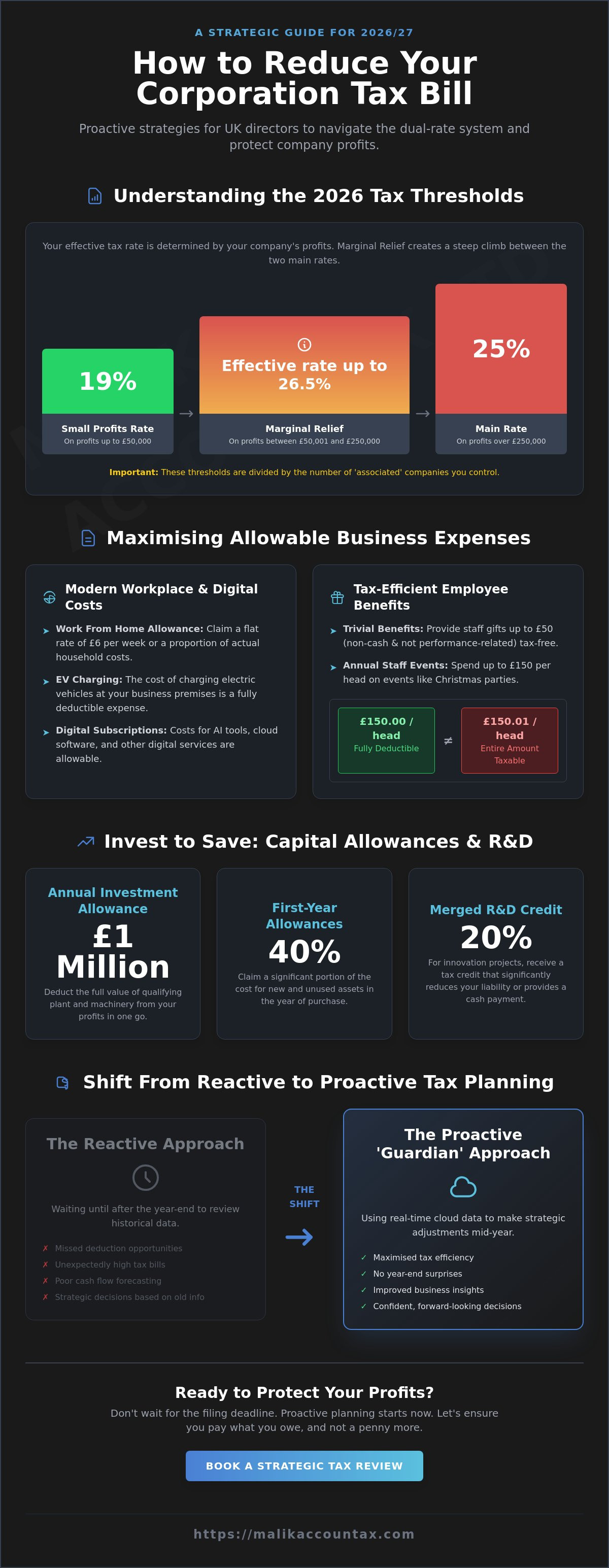
HMRC currently operates a dual-rate system. While the 19% and 25% rates are the headline figures, the real challenge lies in the "Marginal Relief" band for profits between £50,001 and £250,000. Marginal ReReliefs is a mechanism to smooth the transition between tax bands. Without precise forecasting, you might find your effective tax rate climbing much faster than anticipated. 2026 demands meticulous accuracy because these thresholds are shared amongst associated companies. If you have multiple business interests, those £50,000 and £250,000 limits are divided, meaning you must work harder to reduce the corporation tax bill across all entities.
Why Proactive Tax Planning Beats Reactive Filing
Traditional accounting often relies on "looking back" at historical data. This reactive approach is dangerous. By the time you sit down with an accountant to review last year's figures, the window for strategic adjustments has already closed. The Malik AccounTax Ltd approach uses real-time cloud accounting insights to provide "Guardian-style" oversight. This foresight allows us to identify opportunities to reduce the corporation tax bill whilst the financial year is still active. Chartered expertise goes beyond basic bookkeeping; it helps you protect your profits and advance your business. Clear books lead to confident decisions—every time.
Maximising Allowable Business Expenses: Every Penny Counts
Every pound you claim as a legitimate business expense is a pound HMRC cannot tax. The golden standard for these claims is the "wholly and exclusively" rule. This means any cost must be incurred solely for your trade. It sounds simple, but the application requires clinical precision. Meticulous record-keeping is your primary shield against HMRC scrutiny. It is the most direct way to reduce the corporation tax bill without triggering red flags. Receipts fade. Digital records don't. We recommend booking a review of your current systems with Malik AccounTax Ltd to ensure you aren't missing out on vital deductions while they are still fresh in your mind.
Modern Workplace Expenses in 2026
The way we work in 2026 has evolved, and so have the allowable costs. If you work from home, you can claim a flat rate of £6 per week or calculate a proportion of your actual utility costs. For directors in Edinburgh or other UK hubs commuting between sites, sustainable travel is a major focus. Electric vehicle (EV) charging at your business premises is a fully deductible expense. Additionally, the proliferation of AI tools and digital software subscriptions arises as standard operational costs. Identifying these costs early is a strategic way to effectively reduce the corporation tax bill. Clear books. Confident decisions.
Employee Benefits and Trivialities
Boosting morale doesn't have to be a tax burden. You can use the £50 trivial benefit rule to provide small gifts to your team, provided they aren't cash or performance-related. These are tax-free for the employee and deductible for the company. Annual staff events, such as a summer gathering or a Christmas party, allow for a £150 per head expenditure. This includes VAT and transport. If you spend £151, the entire amount becomes a taxable benefit; precision is key. These often-overlooked deductions are a simple way to **reduce the corporation tax ****bill **while growing your internal talent pool. Employees are paid correctly—every time.
Capital Allowances and R&D: Investing to Save
Strategic investment isn't just about business growth; it's a powerful lever to reduce the corporation tax bill. Timing is everything. If you purchase a new van or upgraded IT equipment on the last day of your financial year, you can often claim the full tax relief immediately. This is far more effective than waiting until the first day of the next period. By accelerating these purchases, you shield your current profits from the 25% main rate or the tapered marginal relief bands we discussed earlier. Clear books lead to confident decisions—every time.
Navigating Capital Allowances in 2026
Capital expenditure differs from revenue expenses because it involves long-term assets rather than day-to-day running costs. The Annual Investment Allowance (AIA) remains at £1 million for 2026, providing a 100% deduction for plant and machinery. For companies investing in new, qualifying main rate assets, Full Expensing offers permanent 100% relief. Additionally, a new 40% First-Year Allowance (FYA) for new plant and machinery was introduced on 1 January 2026. Be careful when disposing of assets; selling equipment for more than its tax written-down value triggers a balancing charge. This effectively adds to your taxable profit. Meticulous asset tracking ensures you pay not a penny more than necessary.
R&D for Small Businesses and Startups
Research and Development (R&D) relief is not reserved for scientists in lab coats. If your business is solving technical uncertainties in software development, construction, or manufacturing, you likely qualify. The merged R&D scheme now provides a 20% gross credit on qualifying expenditure. For loss-making R&D-intensive SMEs spending at least 30% of their total expenditure on R&D, a cash credit of up to 27% is available. Edinburgh's tech startups and engineering firms often overlook the costs of technical problem-solving as "just part of the job." At Malik AccounTax Ltd, we help you identify qualifying projects to reduce your corporation tax bill while driving innovation. Expert services, real results.
Strategic Remuneration and Pension Planning
How you choose to extract value from your company is just as important as the expenses you claim. It is a delicate balancing act. A director's salary reduces taxable profit whilst dividends are paid from post-tax profit. This fundamental distinction is why a "one size fits all" approach to payroll often leads to unnecessary tax leakage. By carefully structuring your take-home pay, you can reduce your corporation tax bill while optimising your personal finances. At Malik AccounTax Ltd, we look at the whole picture to find your specific tax-efficient "sweet spot."
The Power of Employer Pension Contributions
Employer pension contributions are perhaps the most efficient tool in a director's arsenal. Unlike dividends, these contributions are treated as an allowable business expense. This means that every pound you move from the company bank account into your pension pot can save you 25% in corporation tax if your profits are in the main rate band. For the 2026/27 tax year, the annual allowance remains at £60,000. You may also be able to utilise "carry forward" rules to mop up unused allowances from the previous three years. It is a proactive way to build personal wealth whilst shielding company profits. Not a penny more.
Optimising the Director's Salary
Setting your salary at the right level is essential for National Insurance (NI) efficiency. For many directors, the most efficient route is to set a salary at the Secondary Threshold of £5,000 to avoid employers' NI, which is currently 15%. Alternatively, you might choose £12,570 to fully utilise your personal allowance whilst still qualifying for the state pension. If you have other employees, you might also benefit from the Employment Allowance to offset NI costs. Be wary of the Director Loan Account; if you owe the company money at year-end, you could trigger a 33.75% S455 tax charge. This is a common trap that Malik AccounTax Ltd helps you avoid through real-time monitoring.
You can also consider employing family members to reduce the corporation tax bill, provided there is a clear "commercial justification" for their role. Their wages must be commensurate with the work actually performed to remain compliant. To ensure your remuneration strategy is as efficient as possible, book a tailored tax planning session with Malik AccounTax Ltd today. We handle the messy details so you can focus on your passion. Clear books. Confident decisions.
The Malik AccounTax Ltd Proactive Approach to Profit Protection
Malik AccounTax Ltd is far more than just a digital portal or a distant online service. We act as your proactive guardians. Many directors find themselves frustrated by accountants who only look at figures once the year has already ended. By then, it's too late to make meaningful changes. Our approach relies on real-time insights and monthly management accounts rather than annual surprises. This level of visibility allows us to identify every opportunity to reduce the corporation tax bill whilst the financial year is still active. Our clients typically save 15-30% on avoidable tax exposure because we don't wait for deadlines to start planning.
Expert Services, Real Results in Edinburgh
Local expertise matters for Scottish businesses navigating the UK-wide tax landscape. Whether you are dealing with company formations or scaling a startup, you need a partner who understands your specific journey in Edinburgh and beyond. We bring chartered expertise to every interaction, ensuring your records meet the highest standards of precision. From CIS contractor calculations to complex VAT returns, we handle the technical rigour so you can focus on your passion. Our "Not a penny more" promise isn't just a slogan; it is a commitment to protecting your bottom line through meticulous, tailored advice. Expert services. Real results.
Ready to Protect Your Bottom Line?
The shift from financial uncertainty to total confidence begins with a single, stress-free consultation. We specialise in setting up cloud accounting software that gives you a real-time view of your liabilities, helping you reduce corporation tax bill exposure throughout the year. No more guessing. No more stress. We streamline your bookkeeping and protect your profits from unnecessary exposure, moving you from a financial mess to total clarity. Clear books. Confident decisions. Every time.
Tired of dealing with your accountant? Switch to Malik AccounTax Ltd today. We are ready to provide the attentive, energetic support your business needs to move forward in 2026 and beyond.
Take Control of Your 2026 Tax Strategy
The 2026 tax landscape is undeniably complex. Between the 25% main rate and the intricate marginal relief calculations, sitting back is no longer an option. Success requires more than just recording receipts; it demands a proactive approach to capital allowances, R&D credits, and tax-efficient remuneration. By aligning your director's salary with the correct thresholds and utilising employer pension contributions as an allowable expense, you can significantly reduce your corporation tax bill whilst building personal wealth. Clear books lead to confident decisions.
You don't have to navigate these rules alone. As Edinburgh-based Chartered Accountants and real-time cloud accounting specialists, we help our clients shield their profits from unnecessary exposure. Our clients typically save 15-30% on avoidable tax through our meticulous planning and "Not a penny more" promise. We handle the messy details so you can focus on your passion. Maximise your profit and reduce your tax bill with Malik AccounTax today. Let's propel your business forward with precision and peace of mind.
Frequently Asked Questions
Is it legal to reduce my Corporation Tax bill?
Yes, it is entirely legal to use HMRC-approved reliefs and allowances to reduce your corporation tax bill. This practice is known as tax avoidance; it involves proactive planning to ensure you pay no more than required. It is distinct from tax evasion, which is illegal. By claiming legitimate expenses and capital allowances, you remain fully compliant, protect your company's bottom line, and advance your business.
Can I claim my home office as a business expense in 2026?
You can claim home office costs either as a flat rate of £6 per week or as a proportion of your actual utility bills. For directors working from home in 2026, the proportional method often yields higher savings if you have a dedicated workspace. Please calculate the percentage based on the number of rooms used and the time spent working, in line with HMRC's strict criteria. Precision is vital here to avoid future disputes.
What happens if I pay my Corporation Tax early to HMRC?
HMRC pays you "credit interest" if you pay your tax earlier than the deadline. This interest is usually calculated from the date of payment until the date the tax is actually due; it applies if you pay at least 6 months and 13 days after the start of your accounting period. It's a small, proactive way to gain a financial advantage while ensuring your compliance is handled well in advance. Confident decisions start with early action.
How does Marginal Relief affect my small business tax rate?
Marginal Relief is a sliding scale that increases your effective tax rate as your profits move from £50,000 toward the £250,000 threshold. If your profits are £50,000, you pay 19%. As profits rise, the Relief decreases until you hit the full 25% rate. This mechanism ensures there isn't a sudden cliff edge in tax liability, but it requires meticulous forecasting to manage effectively and avoid unnecessary financial strain on your cash flow.
Can pension contributions really save my company 25% in tax?
Pension contributions can save your company 25% in tax if your profits exceed the £250,000 main rate threshold. Because employer contributions are an allowable business expense, they reduce your taxable profit before the tax is calculated. This is a highly efficient way to reduce your corporation tax bill whilst simultaneously building your personal wealth for the future. It's a win-win strategy that turns a tax obligation into a long-term personal asset.
What is the "Wholly and Exclusively" rule for business expenses?
The "Wholly and Exclusively" rule dictates that an expense must be incurred solely for your trade to be tax-deductible. If a cost has a duality of purpose, such as ordinary clothing that you also wear outside of work, HMRC will typically disallow it. We ensure your records are meticulous so that every claim meets this clinical standard of professional rigour. Clear books mean you can defend your position with total confidence.
Should I pay myself a higher salary or more dividends in 2026?
Finding the sweet spot between salary and dividends depends on your specific profit levels and the £12,570 personal allowance. Many directors choose a salary of £12,570 to qualify for the state pension without paying employee National Insurance at 8%. Dividends are then paid from post-tax profits, though you must consider the dividend tax rates of 10.75%, 35.75%, or 39.35%. We provide tailored advice to ensure your remuneration is as tax-efficient as possible.
How much can I save by using R&D tax credits?
Under the merged R&D scheme in 2026, you can receive a 20% gross credit on your qualifying expenditure. If your business is a loss-making R&D-intensive SME spending 30% of total expenditure on innovation, you could receive a cash credit of up to 27%. These credits provide a significant cash injection, rewarding your company for solving technical uncertainties in your industry. Expert services deliver real results for tech-savvy businesses across Edinburgh and the wider UK.
Disclaimer
Disclaimer: The information provided on this website is for general informational purposes only and does not constitute accounting, tax, legal, or financial advice. While every effort is made to ensure accuracy, Malik AccounTax accepts no responsibility for any loss arising from reliance on the information contained on this website. Professional advice should always be obtained based on your individual circumstances.