
What if the biggest threat to your bank balance isn't the taxman, but the receipts you've accidentally binned? With over 4.2 million self-employed individuals in the UK as of early 2026, the pressure to get your figures right has never been higher. You've likely sat at your desk, wondering what you can claim on Self Assessment while staring at a confusing mix of petrol receipts and home office bills. It's exhausting to worry about HMRC penalties or whether you've correctly split the cost of a dual-purpose mobile phone. We know you want to protect your hard-earned income, not lose it to avoidable errors.
You deserve peace of mind and a lower tax bill. This guide from Malik AccounTax Ltd reveals exactly which business costs you can deduct to ensure you pay not a penny more in tax than legally required. We will weigh up the clinical precision of modern cloud accounting against traditional paper methods to see which helps you claim every legitimate expense. You'll discover how the 75% of businesses already using digital tools are streamlining their records ahead of the April 2026 MTD deadline, giving you a clear system to organise your finances with total confidence.
Key Takeaways
-
Master the "wholly and exclusively" rule to ensure every business expense you claim stands up to meticulous HMRC scrutiny.
-
Use our comprehensive checklist to identify exactly what you can claim on self-assessment, covering everything from office stationery to specific travel costs.
-
Evaluate whether the simplified flat-rate expenses or a proportion of actual home running costs will yield the highest tax savings for your business.
-
Protect your bottom line by avoiding common HMRC red flags, such as claiming for daily commuting or client entertainment.
-
Streamline your recordkeeping ahead of the 2026 MTD deadline by adopting cloud accounting tools for real-time financial clarity.
Table of Contents
Understanding Allowable Expenses: The "Wholly and Exclusively" Rule
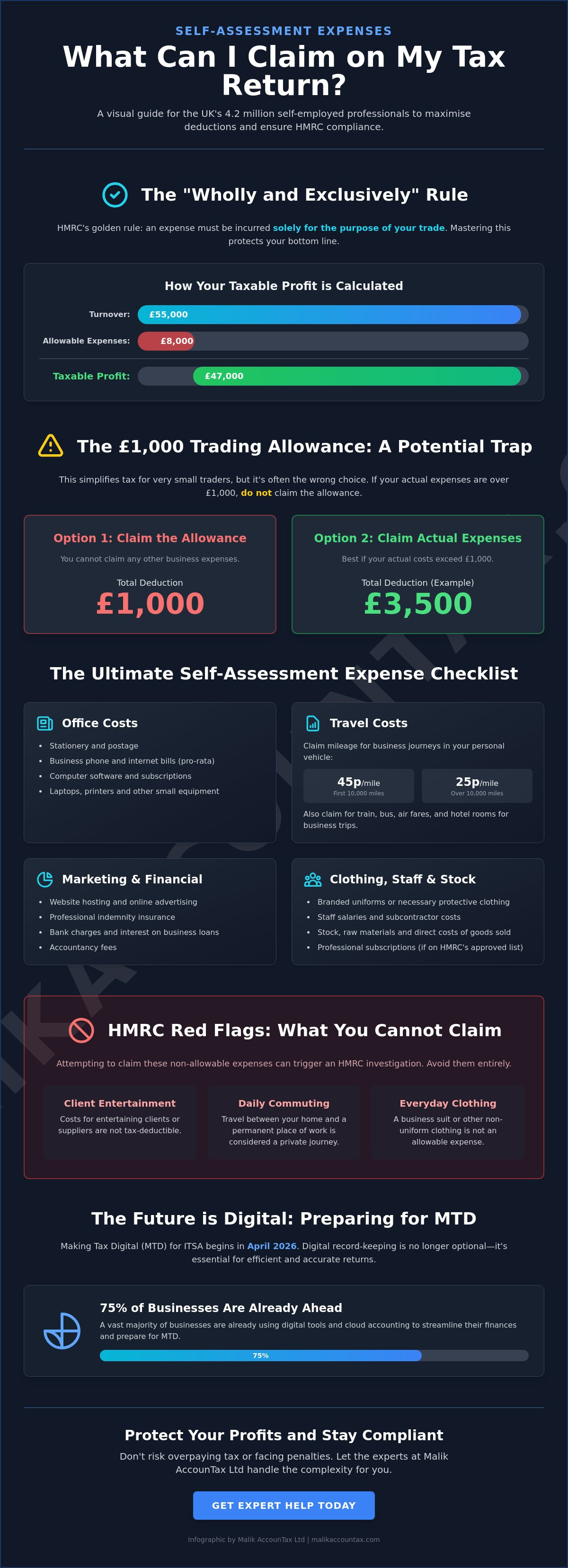
Your taxable profit is a simple equation: turnover minus allowable expenses. If your business brings in £55,000 but you incur £8,000 in legitimate costs, HMRC expects tax on the remaining £47,000. Mastering what you can claim on self-assessment is the most effective way to protect your bottom line and propel your business forward. It's about precision. Meticulous records ensure you pay not a penny more in tax than legally required. At Malik AccounTax Ltd, we believe this isn't about finding loopholes; it's about the rightful application of the "wholly and exclusively" rule to every pound spent. This philosophy shields your hard-earned income from avoidable exposure whilst maintaining full professional rigour.
HMRC's core principle for UK Self-Assessment Tax Returns is that an expense must be incurred wholly and exclusively for your trade. If a cost was purely for your business, it's generally deductible. As we approach the April 2026 transition to Making Tax Digital (MTD), this rule remains the cornerstone of every claim. With HMRC's enhanced ability to scrutinise digital records, your evidence must be bulletproof. Clear books. Confident decisions. Current HMRC guidance for the 2026 tax year emphasises that every pound you correctly identify as an expense is a pound that isn't unfairly taxed. The 2026 thresholds make this clarity even more vital for high earners.
What Happens if an Expense is Dual-Purpose?
Life isn't always neatly divided into "work" and "home". You might use your personal mobile for client calls or your laptop for both work and personal admin. HMRC allows you to claim for the business portion of these costs. Apportionment is the process of dividing a cost into business and private elements based on a fair and reasonable calculation. For instance, if 60% of your mobile phone data is used for business purposes, you can deduct 60% of the monthly bill. We recommend reviewing these percentages annually to ensure they reflect your current usage patterns. Expert services. Real results. This meticulous approach ensures your claims are both maximised and defensible.
The £1,000 Trading Allowance Warning
The £1,000 trading allowance is a tax-free "gift" for those with very low business income. It's designed to simplify things for casual sellers or hobbyists. However, there's a catch. If you claim this allowance, you cannot deduct any business expenses. For established sole traders, this is often a trap. If your actual business costs exceed £1,000, you should always claim specific expenses rather than the allowance. This strategic switch maximises your tax relief and reflects the true reality of your business overheads. Don't leave money on the table because of a desire for simplicity. We help you navigate these thresholds to ensure your tax efficiency is at its peak.
The Ultimate Self-Assessment Expense Checklist
Precision matters. Every receipt tells a story about your business and its growth. When you begin to categorise your spending, the question of what you can claim on self-assessment becomes much clearer. The Official Government Guidance on Expenses provides a framework, but applying it to your specific situation requires a meticulous eye. Start with your office costs. Stationery, postage, and small equipment like laptops or printers are all deductible. These are the small wins that, when added up, significantly shield your profits.
Travel is another major category where many business owners leave money on the table. For the 2025/26 tax year, you can claim 45p per mile for the first 10,000 miles driven in a car or van, and 25p per mile thereafter. This covers fuel and parking, but your daily commute to a permanent place of work is not allowable. Beyond the physical, don't forget marketing and financial costs. Website hosting, professional indemnity insurance, and even the interest on business loans are all legitimate deductions. If you feel buried under a mountain of paper, our experts can help you streamline your bookkeeping to ensure every pound is accounted for.
Clothing, Staff, and Reselling Goods
HMRC is particularly vigilant regarding clothing claims, making it a common red flag. You cannot claim for a sharp suit or everyday workwear, even if you only wear it for client meetings. Deductions are strictly limited to branded uniforms or essential protective gear. For teams, you can deduct staff salaries and subcontractor costs, provided you maintain strict PAYE or CIS compliance. If you sell physical products, the cost of raw materials and stock bought for resale is a fundamental deduction—meticulous recordkeeping is required. Real results.
Training and Professional Development
Investing in your expertise is vital to propel your business forward. HMRC allows you to deduct the cost of training that refreshes or updates your existing skills. If you're a consultant attending a seminar on new regulations, it's a legitimate claim. However, learning an entirely new trade is typically considered a capital expense and isn't deductible from your trading profits. Always include your professional association fees and trade journal subscriptions; these are essential deductions that prove you're keeping pace with your industry. When considering what I can claim on self-assessment, these professional costs are often the most overlooked.
Working from Home: Simplified Expenses vs Actual Costs
If you operate your business from a home office, you face a critical choice that directly impacts your tax liability. HMRC provides two distinct methods for calculating these costs: the "Simplified Expenses" flat rate and the "Actual Costs" method. Choosing the right one ensures you protect your bottom line. For many sole traders in 2026, particularly those in cities with high overheads like Edinburgh, the difference can amount to hundreds of pounds in tax savings. It's about precision. Clear books lead to confident decisions.
When deciding what to claim on self-assessment, you must weigh the convenience of a flat rate against the potential for a larger deduction through meticulous calculation. Whilst the simplified method requires less recordkeeping, it often fails to account for the true cost of heating, lighting, and broadband in a modern home. To ensure you stay compliant, always refer to the latest HMRC guidance on allowable expenses before finalising your figures. Every pound you correctly identify as a business cost is a pound shielded from tax.
HMRC Flat Rates for 2026
The simplified method uses a tiered monthly flat rate based on the number of hours you work from home. For the 2025/26 and 2026/27 tax years, the rates are as follows:
-
25 to 50 hours per month: £10 per month
-
51 to 100 hours per month: £18 per month
-
101 or more hours per month: £26 per month
The "no-receipts" approach is a major time-saver. You don't need to track every utility bill; you only need to log your hours. However, the "sweet spot" for switching to actual costs usually occurs if you work more than 100 hours a month or live in a property with high rent and utility bills. If your actual business-related costs exceed £312 per year, the flat rate is likely working against you. Real results require looking past the easiest option.
Calculating Actual Home Office Costs
The actual costs method requires a more meticulous approach but often yields significant tax relief. You calculate your claim by totalling your allowable home expenses and apportioning them based on the number of rooms you use for business and the time you spend in them. The standard formula is: (Total Costs / Number of Rooms) x (Business Use Percentage). You can include a proportion of the following:
-
Heating and lighting
-
Council Tax
-
Mortgage interest (not the capital repayment) or rent
-
Home insurance and broadband
Always exclude purely personal rooms, such as bathrooms or kitchens, from the room count to maintain professional rigour. If HMRC conducts a check, you'll need to provide the underlying bills and a clear rationale for your apportionment. We handle the messy details of these calculations so you can focus on your passion.
HMRC Red Flags: What You Absolutely Cannot Claim
Whilst mastering **what I can claim on self-assessment **is empowering, knowing what is strictly forbidden is your best shield against HMRC scrutiny. HMRC data from the 2024/25 tax year reveals that incorrect expense calculations remain the most frequent error on self-assessment returns. Precision is your greatest ally. To protect your bottom line, you must distinguish between legitimate business growth costs and personal spending that HMRC will inevitably flag during a meticulous records check. Professional rigour.
The "Commuting Trap" remains a persistent pitfall for UK sole traders. Although we previously noted that mileage for business trips is deductible, the cost of getting to your regular, permanent place of work is never allowable. Your morning latte or the meal deal you grab on the way is a personal choice, not a business necessity. Similarly, client entertainment is a major red flag. Whilst you can claim for a staff Christmas party within specific limits, buying a coffee or lunch for a prospective client is not a tax deduction. HMRC views this as hospitality, which is specifically barred under current regulations.
Avoid the temptation to include fines or penalties in your calculations. Whether it's a parking ticket incurred on a business trip or a late-filing penalty from a previous year, HMRC does not allow you to offset these costs through tax relief. Every claim must stand up to the "wholly and exclusively" test without exception. If you are tired of dealing with your current accountant and want a partner who prioritises accuracy, the team at Malik AccounTax Ltd is ready to help.
The Danger of "Aggressive" Tax Advice
Be wary of online adverts or unqualified agents promising "secret" ways to slash your tax bill. These "aggressive" strategies often rely on flimsy interpretations of tax law that leave you, the taxpayer, personally liable for any shortfall and subsequent penalties. At Malik AccounTax Ltd, we use our Chartered Expertise to shield you from risk. We act as your proactive guardian, ensuring your claims are maximised within the legal framework so you can focus on your passion with total peace of mind.
Common Mistakes with Legal and Financial Fees
Not all professional fees are created equal in the eyes of the taxman. You can generally deduct legal fees for business operations, such as debt recovery or contract disputes. However, legal costs associated with capital purchases, like buying a new office building, are treated differently and are not deductible from your trading profits. Another nuance involves your accountancy fees; whilst the cost of preparing your business accounts is deductible, the portion relating to your personal tax affairs is technically a private expense. Finally, ensure you only claim interest on loans used strictly for business purposes. Mixing personal debt with business finance is a major red flag that often triggers a deeper HMRC investigation. Real results require real precision.
Organising Your Records for a Stress-Free Tax Return
HMRC requires you to keep your records for at least five years after the 31 January submission deadline. For the 2025/26 tax year, this means holding onto your evidence until at least January 2032. If you are still relying on a "shoebox" method, you are leaving your business vulnerable to stress and potential penalties. Understanding what I can claim on self-assessment is only half the battle. The other half is ensuring your evidence is bulletproof and easily accessible during an HMRC check. Digital recordkeeping isn't just a suggestion; for those with a qualifying income over £50,000, it becomes mandatory from April 2026 under Making Tax Digital (MTD).
Transitioning to cloud accounting now is the best way to shield your business from future disruption. Meticulous bookkeeping does more than satisfy the taxman; it provides a real-time map of your financial health. When your books are clear, your decisions are confident. At Malik AccounTax Ltd, we pride ourselves on a warm, personal touch that removes the clinical coldness often found in chartered firms. Our goal is to streamline your self-assessment process so you pay no more in tax than legally required. Expert services. Real results.
A Proactive Recordkeeping System
A clear system protects your bottom line. It transforms accounting from a year-end headache into a tool that helps you propel your business forward. Follow these three steps to streamline your admin:
-
Step 1: Use a dedicated business bank account. Never mix personal spending with business transactions. It speeds up reconciliation and significantly reduces the risk of missing a legitimate deduction.
-
Step 2: Capture receipts digitally. Use cloud-based apps to photograph receipts as soon as you receive them. This eliminates the "shoebox" panic and ensures your records are safe from fading or physical loss.
-
Step 3: Reconcile your books monthly. Don't wait until January. Reviewing your income and expenses every 30 days provides real-time clarity on your cash flow and prevents errors from snowballing.
Why a Chartered Accountant is Your Best Investment
Professional rigour delivers tangible financial benefits. Our clients typically save 15-30% on avoidable tax exposure by applying our Chartered Expertise to every line of their accounts. Beyond the standard tax return, we provide management accounts that offer deep insights into your business performance. This allows you to make confident decisions based on precision, not guesswork. We handle the messy details so you can focus on your passion. Tired of the tax return stress? Let Malik AccounTax Ltd handle your Self Assessment today.
Take Control of Your Tax Efficiency Today
Precision is more than just a preference; it is a financial necessity for every UK sole trader. Understanding exactly what you can claim on self-assessment ensures your business remains resilient against the rising costs of the 2025/26 tax year. Whether you are calculating flat rates for working from home or meticulous mileage logs, every pound correctly identified protects your bottom line. Clear books. Confident decisions. By embracing digital tools now, you'll be perfectly positioned for the April 2026 MTD deadline.
You don't have to navigate these complex regulations alone. As Chartered Accountants with local Edinburgh expertise, we provide proactive tax planning to help you manage risk. Our "not a penny more" promise means you keep more of what you earn whilst we handle the messy details. Clients who switch to our tailored approach typically save 15-30% on avoidable tax exposure. Get Expert Self-Assessment Help in Edinburgh and propel your business forward today. Expert services. Real results. Your business deserves a partner as invested in your success as you are.
Frequently Asked Questions
Can I claim for my mobile phone bill if I use it for both business and personal calls?
Yes, you can claim for your mobile phone bill, but you must apportion the cost to reflect only your business usage. If you spend 40% of your time on client calls, you deduct only 40% of the monthly bill. Meticulous logs or itemised billing are the best evidence for an HMRC check. We help you calculate this percentage with precision, so you pay not a penny more in tax.
How much can I claim for working from home in the 2025/26 tax year?
For the 2025/26 tax year, you can claim a flat rate of up to £26 per month if you work 101 or more hours from home. If your hours are between 25 and 50 per month, the rate is £10. When wondering what you can claim on self-assessment, remember that calculating actual costs for heating and rent might yield a higher deduction if you live in a high-cost area.
Is food and drink an allowable expense for a sole trader?
Food and drink are typically not allowable expenses for a sole trader because everyone must eat to live. You can only claim for meals if they are part of "reasonable" overnight business travel or if your work pattern is significantly different from your normal routine. Every day, lunch is a personal cost. HMRC applies the "wholly and exclusively" rule strictly to prevent personal spending from reducing your tax bill.
Can I claim for my commute to work?
No, you cannot claim for your daily commute to a permanent base of operations. HMRC considers travel between your home and your regular workplace to be private travel. You can, however, deduct costs for travel to temporary sites where you work for less than 24 months, or for visiting a client's premises for a specific meeting. Clear books and travel logs are essential for proving these journeys are legitimate.
What records do I need to keep to prove my expense claims to HMRC?
You must keep all purchase receipts, bank statements, and proof of payment for at least five years after the filing deadline. With the 2026 MTD transition approaching, capturing these documents digitally using cloud software is the most efficient way to maintain professional rigour. Precise records shield you from the stress of an audit. Digital capture ensures your receipts don't fade or get lost in a shoebox.
Can I claim the cost of a new laptop on my Self Assessment?
Yes, a new laptop is a legitimate deduction, usually claimed through capital allowances rather than as a day-to-day expense. If the device is used solely for business, you can often deduct the full cost in the year of purchase. If it has a dual purpose, you must reduce your claim by a fair and reasonable percentage for personal use. Meticulous apportionment protects your bottom line and keeps you compliant.
What happens if I accidentally claim for something that isn't allowed?
If you discover an error, you must amend your tax return as soon as possible to avoid or reduce HMRC penalties. Proactive correction demonstrates a responsible attitude toward compliance. Leaving an incorrect claim on your record is a major red flag that could trigger a full investigation into your finances. Our chartered expertise helps you navigate these "messy" details to ensure your return is accurate from the start.
Can I claim for professional subscriptions or trade union fees?
You can claim for professional subscriptions if the organisation is on the HMRC-approved list and is directly relevant to your trade. When considering what I can claim on self-assessment, remember that trade union fees are generally not deductible. However, fees for chartered bodies or industry journals are vital for your professional development and are fully allowable. These costs prove you are keeping pace with your industry.
Disclaimer
Disclaimer: The information provided on this website is for general informational purposes only and does not constitute accounting, tax, legal, or financial advice. While every effort is made to ensure accuracy, Malik AccounTax accepts no responsibility for any loss arising from reliance on the information contained on this website. Professional advice should always be obtained based on your individual circumstances.